New paper: Wax, minds, and Aristotelian bodies

Comments welcome, as usual. This paper is the product of wrestling with how a debate in secondary literature on pre-modern philosophy remains wedded to paradigms inherited from modernity. The result is to show that certain assumptions about matter inherited from early modern physics aren’t at all plausible, and that Aristotle’s physical theory remains markedly more plausible in its general contours, if not always in its details. Here is an abstract.

Abstract: In a series of articles, Myles Burnyeat has suggested that Aristotle’s psychology is no longer credible because it presupposes a post-Cartesian conception of matter that none of us, functionalists or not, can share. By focusing on the employment of Aristotle’s and Descartes’ uses of a common example – the relation of a piece of wax to its shape – I pinpoint where exactly this disagreement lies. While there are major differences between an Aristotelian and a Cartesian conception of matter, the Aristotelian account is by no means as incredible as Burnyeat takes it to be. Moreover, Aristotle himself addresses a conception in many respects like that given by Descartes, and explicitly rejects it.

and here is the paper.

New paper: The monadothergy

Today, I’m presenting an abridged version of the linked paper at the annual meeting of the North American Levinas Society, which I’m also posting in the My papers section of the website. Here is an abstract:

Abstract: This paper approaches the question of Levinas’ relation to philosophy by situating his understanding of transcendence next to that of Leibniz. After offering some preliminary examples, I detail the structure of transcendence in the philosophies of Leibniz and Levinas, focusing on Leibniz’s Principles of Nature and Grace and Levinas’ Essence and Disinterestedness. From here, I return to the question of whether Levinas’ thinking can be regarded as moving beyond philosophy as such. I conclude with some thoughts on what it would take for a thinking of transcendence to genuinely move past the maneuvers so characteristic of philosophical thinking.

***

The paper is in certain respects more offbeat than most of my other work, and doesn’t easily fit the content or tenor of many journal discussions. It is also one of the works I’m most proud of, mostly because it attempts to state something of lasting importance, and I think states it well. If the paper is read primarily as a comparative exegesis of two thinkers, then the reader may be disappointed. Rather, the aim is to open up an understanding of transcendence, and with it, of the nature of philosophy itself, through a comparative reading of Leibniz’s and Levinas’ texts. Approach this one in the first place as a philosopher asking philosophical questions, not as a scholar with scholar’s concerns, and you may benefit from reading it, as I have from writing it.

The Monadothergy

The Monadothergy figures

On blind review

1 Gaps and generics in the blind review process

Journals intend reviews of submissions be blind in order to ensure non-biased treatment of the material under consideration. The main assumption supporting this approach is that when work is presented anonymously, reviewers will set aside judgments concerning the race, gender, age, professional status etc. of the author considered. To provide an image of the reviewer’s mind on this model, it is as if one found an empty space where one previously found opinions about such matters. Call this the gappy thoughts model of blind review.

Blind reviewers do not have gappy thoughts. The content that otherwise would have been associated with an author remains filled. But it is filled generically.

Suppose a professor teaching a mixed graduate and upper-level undergraduate course grades course materials anonymously. Suppose further that in this class, upper-level undergraduates outnumber graduates by a factor of roughly 2 to 1. In this situation, for any given paper, the professor will be somewhat more likely to assume the work he is grading was written by an undergraduate, unless content strongly suggests otherwise. And so, for instance, sentential ambiguities will be more liable to be understood in a way that assumes less, rather than more understanding on the part of the student.

Similarly, if a reviewer assumes that most submissions to the journal requesting her feedback are term papers written by graduate students, she will be more apt to suppose grad student authorship in ambiguous cases. Conversely, if the reviewer assumes that only established scholars contribute to the same journal, she will be more apt to assume – perhaps consciously, perhaps not – that the paper written on topic x by so-and-so’s doctoral student was written by his mentor.

More generally, the practice of blind review doesn’t essentially contribute to the diversity of philosophy, if by this we understand something more than the adoption of majority standards by non-dominant groups. Instead, it encourages non-dominant groups to conform to the style and substance of the dominant group: it encourages conformity to the generic. Thus, blind review tends toward a stronger kind of equality than its intended aim would suggest: sameness.[1]

2 The situation of blind review with respect to the author and authorship

Anonymity tends toward irreverence. For proof of this, see the internet. Therefore, work encountered anonymously that does not conform to the standards of the philosophical community is more likely to be judged as failing to meet those standards than challenging or surpassing them. This is part of why authors try to subvert the blind review process in all the ways listed here. Established scholars may do so, for instance, via conspicuous self-citation. Less established scholars may do so by circulating their work among more established scholars, or by publishing drafts on sites like academia.edu, where they can get feedback from interested readers.

Two likely consequences follow.

First, to the degree that it is flouted, blind review may end up hurting the very people it intends to help: less established or otherwise marginalized scholars without strong connections to others in their field, given that such people are the most likely victims of the irreverence frequently accompanying anonymity.

Second, assuming that the values of a group are more likely to be internalized by those on the margins seeking its acceptance than those squarely in it, marginalized members would be less likely to do things that might undermine the egalitarian ideals the process of blind review intends to support. And so, for instance, they would be less likely to do some of the very things that would help them – for instance, sharing their work with others – for fear of undermining the aims of the blind review process. In this way, we witness a tension between two growing aspects of both academic philosophy and culture at large: the strong egalitarianism embodied in western liberal notions of fairness, and the strong communitarianism present in the ever-increasing connectedness of our world.

The hidden link tying together the whole process may well be this: the ideal of the scholar as solitary genius. This is likely the background assumption without which it makes little sense: to discourage interaction, rather than encourage it; to assume that reviewers will take a positive, reverent attitude toward an author, rather than a more vulgar stance; to expect inspired but remarkably different viewpoints to traditional questions to be celebrated rather than denigrated.

[1] This isn’t to say that blind review should be abandoned. It may still be the best viable alternative among many bad options.

New paper: Leibnizian intelligibility

I’ve added a new paper to the My Papers section of the site. Here is a PDF. Comments welcome. Here is an abstract.

Abstract: It is well-known that Leibniz rejected the accounts of gravitation offered by Newton and his followers. But literature on the topic up to present has been content either i) to explain this rejection as a consequence of Leibniz’s rejection of the intelligibility of action at a distance; or ii) to regard Leibniz’s rejection, given his acceptance of his own notion of force, as unjustified. This article provides a fuller account of why Leibniz regarded Newtonian gravitation as unintelligible. The paper divides into two parts. The first part shows that neither of the above explanations suffices to explain Leibniz’s rejection of Newtonian gravitation. The second part explicates the notion of intelligibility standing behind Leibniz’s charge against the Newtonians. In this part, I begin by cataloguing a list of physical hypotheses that Leibniz takes to be unintelligible. I then move to the positive account of intelligibility Leibniz gives in his correspondence with Christian Wolff. Thereby, I show that the different Newtonian accounts of gravitation each undermine the Leibnizian theological tenet that this is the best of all possible worlds.

On the sociology of the analytic-continental divide and its passing

Though I am friendly towards continental philosophy, I do not really identify with it. I tend to locate the split between analytic and continental philosophy fairly recently, at the time of the French explosion of the late 1960’s with Derrida, Foucault, and Deleuze, among others, and think of it largely as an Anglophone, especially an American phenomenon. The dominance of analytic philosophy in the English-speaking world could only have occurred after the rise of a particular university culture in English-speaking countries at large: without the ideal of everybody having a degree, it would not be generally possible for analytic philosophers to focus on “research”, “rigor”, being on the “cutting edge”, etc., since the economic resources for the possibility of the kind of deep compartmentalization constitutive of analytic philosophy weren’t yet present.

By contrast, the tendency among continental philosophers to stress broad knowledge of the philosophical tradition can only be accounted for in its present form as a minority reaction to the development of the research university and the kind of philosophy it encourages. As such, continental philosophy takes advantage of a tension in the culture of American higher education between research and liberal arts universities, a tension that doesn’t appear to be as present in the cultures of the UK or many countries on the European continent. This helps explain the more widespread presence of respected philosophers pre-1970 who don’t neatly fit into either tradition, e.g. Thomas Kuhn, Dietrich von Hildebrand, Jacques Maritain, even Kurt Gödel.

What we are witnessing today is not so much an overcoming of a divide as a growing out of it. The disputes of the past don’t have the same gravity for younger researchers that they do for their older colleagues. The result is a watering down of not only the vices, but also the virtues of both traditions. Future philosophers will be less prone to obscurantism or logic-chopping; they will also be less likely to be a Heidegger or a Wittgenstein. Both the characteristic virtues and the vices of the coming generation are likely to be different.

More on this later.

On the future of research in the history of philosophy

Many problems in research in the history of philosophy arise from a basic orientation of philosophy at research institutions: philosophers in general tend to be more concerned about the present and future than about the past. Quine and those influenced by him, for instance, are explicit in regarding theories even in history as fundamentally guided by concerns about prediction; more concretely, much literature on nearly any topic is primarily concerned to see if the argument “works”–that is, is able to do work for us. This basic tendency to evaluate everything on the basis of its ability to be appropriated leaves many philosophers unequipped to engage in research on more than individual figures for the sake of more than adopting them for contemporary needs.

A mark of this tendency is the ease with which much research in the history of philosophy can be taxonomized into two approaches: the one I shall call the ‘necromantic approach’; the other, ‘Mormon genealogy’. [i]

The aim of the necromantic approach is to resurrect the mighty dead in order to get into an argument with them. This approach tends to focus on well-known figures (there’s not much value in picking a fight with the feeble dead), with an eye towards appropriating their ideas for contemporary purposes.

The Mormon genealogist, by contrast, baptizes his roots: he does not raise the dead to slay them, but redeems them by linking them to something greater – the attitudes and contributions of the researcher’s own generation. One finds this approach in the naming of contemporary principles and positions for thinkers who couldn’t possibly have known or held them (e.g. ‘Hume’s Principle’, ‘Neo-Humeanism’); in the assimilation of ancient theories to contemporary ones (e.g. Aristotle’s physics and psychology to contemporary functionalism); in the myriad works tracing the origins of scientific method to the later Middle Ages, the historical-critical method to Medieval biblical exegesis, contemporary advances in mathematical logic to Medieval logicians, etc.

Neither of these approaches addresses history in the manner in which it addresses us.

‘History’ names the past. The fundamental givenness of the past in its pastness is as weight. The past is what presses us. As pressing, it presses us toward some end. This is the basis for the connection fashioned by ancient peoples between the star of one’s birth and one’s destiny.

The recognition of weight grounds the recognition of my own history as mine. This weight is given prior to any assessment of its value or goodness. Whether the weight of history be one of sin or of glory, it prepares a rapport of its bearer towards a future.

The name ‘history’ specifically signifies the past in its wholeness. This is why the French ‘l’histoire’ means both ‘history’ and ‘story’; it is also why our removal from an authentic experience of history should be accompanied by an increasingly atomistic approach to historical research. The necromantic approach only values the thinker by de-historicizing him. The genealogical approach treats the thinker as a node to be connected with other nodes in order to reconstruct channels of influence. The atomistic presuppositions behind both projects are a fiction. Ideas do not come from thinkers, nor does their transmission resemble that of your cell-phone data to the government.

Though the pressure associated with research in philosophy is great, the direction of research itself increasingly demands that no attention be given to research as pressure. Recall the following from Kant’s “What is enlightenment?”

  • The officer says: “Do not question – drill!” The tax collector: “Do not question – pay!” The pastor: “Do not question – believe!”

To these we may add the mandate of the university itself:

  • Do not question – write!

What is most uncanny here is that the mode of futurity assumed by historical research divorces it not merely from the experience of history in its pastness: in doing so, it also deprives the researcher of an originary experience of futurity. Futurity is authentically given as what is to come. As such, it may be longed for, anticipated, feared, dreaded. One comes to a future out of a past, like an arrow to its mark from the taut bow. Instead of this, futurity is present to the researcher in the mode of optionality. It is that which is available for the choosing from a position of superiority.

Where there is no reckoning of ground, neither is there the reckoning of a height to be reached; and a thinker who does not think through an inheritance does not think.

[i] The first phrase comes from Charles Pigden. See Charles Pigden (2015). “Scott Soames: The analytic tradition in philosophy, volume 1: Founding giants” Philosophical Studies 172: 1671-1680. The second was suggested to me by a medievalist in Europe in private correspondence.

A rule for commenting on philosophy blog posts

A rule for commenting on philosophy blog posts

Before posting your comment, read each and every previous comment. Only comment if the point you wish to make has not been previously stated by someone else in some form.

The justification of the rule

A post, along with its comments, is the unified work of a collective body. While it typically has one principal architect (i.e. the author of the post), a number of individuals will make contributions to the final form of the work – primarily through its comments section.

As a work, the post, along with its comments, is precisely not a documentary of a moment in time, but rather, has something artificial to it. In live talk, a latecomer to a conversation might need to be updated on the previous topics of conversation, leading to considerable repetition; whereas in the literary form of a philosophical dialogue, such a newcomer may come across as having no such need, as though he had been listening in on the conversation all along. In the latter case, the shift from the spoken to the written word brings with it a corresponding shift in the character of the text, from the transience of the utterance to the stability of the written mark. The spoken word moves from absence to presence and back again; the written manifests itself simultaneously as a synoptic whole. As text, the work is a concrete unit of simultaneous presencing, bringing with it the impression that all of its participants share a panoptic view of it.[1]

Because of this, the post-with-comments is governed by the ideals of good philosophical writing in general: specifically, by the idea that powerful speech is parsimonious speech; and in particular, by the idea that redundancy is to be avoided. Repetition crowds out: it disrupts the integration of the various parts of the conversation, and therefore serves to obfuscate the whole rather than foster its clarification as a whole. Verbal economy, by contrast, promotes the essential integrity of the totality.

[1] This remains the case even when the standpoint of some of the participants is what we would call ‘incomplete.’ The standpoint of a Glaucon is incomplete not because it fails to grasp all of the parts of the conversation, but because it fails to grasp the whole in its fullness: the failure is a one of depth rather than breadth.

This is also a key difference between philosophical fiction and tragedy: in the latter, but not the former, one often encounters precisely this other sort of partiality, where the hiddenness of some piece of information sets the series of events on a certain course.

On teaching as authority and mediation

In its fourth chapter, the Chicago Handbook for Teachers (2nd edition) advises the following when lecturing:

“Speak loudly and forcefully, both to ensure that everyone in the room can hear you and so that you do not seem tentative or unsure…Look directly at your audience as much as possible…be sure to speak in a deliberate and unrushed way…Change your inflections and even your pace as you move from one kind of statement to another…And finish on time.” (43)

Overall, the above advice leaves the following impressions:

  1. For the purposes of teaching, it is best that the teacher be both knowledgeable and confident. But if the teacher is lacking in either of these areas, feigned confidence is on the whole preferable to candid disclosure of one’s weakness.[1]
  2. A skilled lecturer ought to be able to control his environment. This is partially achieved through the speaker’s ability to make his presence known through voice[2] and through eye contact.[3]
  3. Though the pace of the lecture may change slightly,[4] the overall mode of presentation should be grave.[5]
  4. The lecture must have a beginning, a body, and an end, fit into the confines of the time allotted. There must be a kairological unity not only to the semester, but also to the individual lecture units that make up a semester.

The authors conclude the above section with the following two maxims:

  1. “In the end, however, the success of a lecture depends on its content, and on your ability to deliver it convincingly.” (45)
  2. “The only things that all lecturers have in common are being clear and articulate, being organized, and being engaged.” (45)

This implies the following:

  1. A lecture is divisible into two components: content and presentation. The content will have its own draw: the lecturer is responsible for the presentation of that content.
  2. The job of the lecturer is to “convince” his students. More adequately, the lecturer serves as a medium whereby the content itself convinces the student.
  3. As a consequence of this intermediary role, the lecturer must retain an element of invisibility: he must be “clear”. The ability of a lecturer to fulfill his function depends on his ability to fit well within this hierarchy: he must be “organized,” not merely in the sense of being well prepared, but more than this, to be well prepared to fulfill one’s role within the systematic transfer of knowledge—i.e. to be “organized” in the sense of being oneself in one’s right hierarchical place.[6]

On the whole, these statements place the lecturer in a tendentious position: the lecturer, qua mediator, tends teleologically towards his anonymity: the role of the lecturer is self-effacing in the face of the knowledge it seeks to communicate. Thus, in an age of the immediate transferability of any kind of knowledge, even the best lecturer can be viewed not so much as a medium as a barrier to knowledge. The lecturer’s ability to serve adequately depends on the keeping in place of certain material conditions. But as technology demures from these conditions—e.g. microphones ensure that audiences can be larger, and media such as YouTube allows a lecturer a certain ubiquity vis-a-vis his audience—the lecturer’s job security and relative importance catches up with the self-effacing nature of the vocation itself. Thus, the peculiar importance of the lecturer as a mediator of knowledge is denied more and more as other avenues of information exchange open up. This can lead to anxiety and/or loneliness.

On the other hand, the lecturer is, in different sense, opaque: his personal life must remain largely hidden to his students,[7] and even his pedagogical ability is occasionally obscured in order to maintain a position of authority.[8] Thus, while the lecturer is anonymous from the standpoint of the knowledge conveyed, he is fully present in his ability to control the flow of the lecture through rhetorical force—i.e. through his ability to deliver information “convincingly.” Thus, the lecturer’s sense of self-importance is often not composite with the self-effacing telos of his office. This misconstrued relationship can lead to resentment of students, colleagues, and/or “the system.”

If one seeks an academic career, one must instead find a way to navigate this tension between knowledge and force, rhetoric and invisibility. How this is to be done depends on understanding the lecturer as both mediator and authority.

[1] One ought not to “seem tentative or unsure,” even if one, in fact, is.

[2] “Speak loudly and forcefully.”

[3] “Look directly at your audience as much as possible.”

[4] “Change your inflections and even your pace as you move from one statement to another”

[5] “Be sure to speak in a deliberate and unrushed way.” By “grave” I do not mean “deathly serious,” nor do I intend anything about one’s comportment while lecturing. Rather, the word is taken here as recommending a slow but sharp cadence in speech, more reminiscent of Roman gravitas than English gravity.

[6] The hierarchy of knowledge alluded to here is not identical to the institutional hierarchy of the university itself. What is alluded to here is that the teacher’s role as mediator between knowledge and the student.

[7] “Do not…allow a lecture to become the occasion for elaborate explorations of your personal history” (44)

[8] “You can obscure a great deal of your own anxiety simply by speaking emphatically and clearly” (43).

On the Genesis of New Philosophical Subdisciplines

There are two main means whereby new philosophical subdisciplines are generated today.

The first takes a science distinct from philosophy as a subject of study in its own right. This is the cause of the generation of ‘philosophy of’ disciplines like philosophy of physics, biology, mathematics, etc.

The second operates via the assumption that there is something into which being and some other matter can be divided as members of a common genus, from which the other member of this genus can be separated out as a distinct object of study. Correlatively, the disciplines studying these other matters are themselves divided against metaphysics as the science of being.

The first mode suffices to generate disciplines that, while they retain some interest for a time, maintain a subordinate place within the overall organization of the philosophical sciences.

Furthermore, the level of activity generated in this kind of subdiscipline will be proportionate to the admiration held for it in the wider culture, i.e. proportionate to the prominence that science holds in the culture. For instance, for as long as the relative esteem for the sciences remain as they are at present, the quantitative output in philosophy of physics will surpass that in philosophy of biology.

Lastly, the existence of such disciplines is distinctly modern, in that it puts in action a presupposed distinction between philosophical and scientific method: such disciplines can arise today only on the presupposition that the methods practiced by these sciences are themselves insufficient to capture their own activity. [1] This is why today there can be a philosophy of psychology, but no philosophy of philosophy-of-mind.[2]

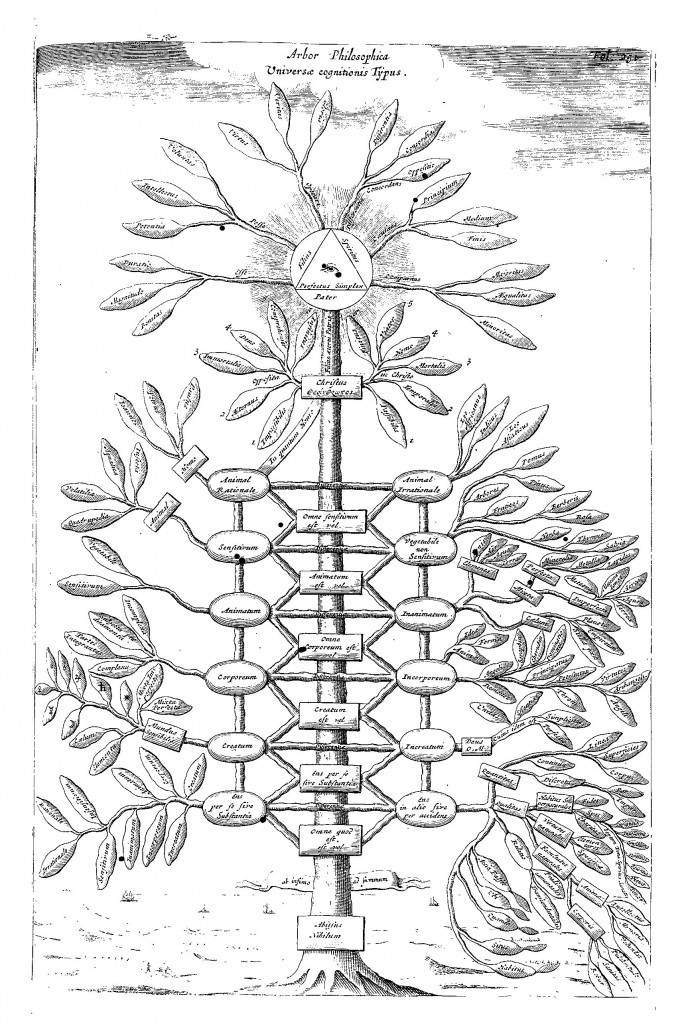
The second mode, much older, is that whereby new core disciplines in philosophy are generated. Take the phrase “Being and          “, and fill in the blank, and that blank will itself correlate to a distinct core philosophical discipline at a given period. In Ancient Greek philosophy, being is divided against becoming; accordingly, metaphysics is divided against Aristotelian physics, a contrast from which the former discipline receives its name. In the early modern period, being, as material being, is contrasted with both thought and thinking; accordingly, epistemology and philosophical psychology take up a central place. In Kant, we have the separation of being from the realm of the ought or value. This gives rise to modern ethics.[3] In a move beginning with Leibniz and coming to fruition in Husserl, we see the pair being/appearing (which itself goes back to Plato) come to the fore; accordingly, phenomenology comes to form a core part of Continental philosophy, a place it still occupies today. And at the dawn of the analytic tradition, we have the pair being/language. This begets philosophy of language, and provides it with the centrality it had in both the regimenting tradition represented by Russell, Quine, and Tarski; and the ordinary language tradition of Ryle and Austin. This further explains why, in spite of its name, philosophy of language is a discipline of the second rather than the first type.

At the time that a new discipline of the second type arises, it is characterized in each case by a special relation to metaphysics. Often, the discipline becomes something of a rite of passage, a sine qua non for grasping being itself. This is the role taken up by physics in Aristotle, as well as by epistemology in the early modern period.

Other times, the object takes on the character of an insurmountable barrier. Thought does this in later modernity. Accordingly, the discipline studying that object may take on the character of a kind of guardianship, barring the path to superstition. Philosophy of language takes on this prohibitive role in the attitude of the Vienna circle.

Other times, the discipline may merely concede the study of being to another realm, typically on the assumption that the discipline can do well enough without it. This is the attitude of the early Husserl, who concedes the task of studying being to the positive sciences, taking phenomenology to open up a realm distinct from the reach of those sciences and interesting in its own right. This also remains the dominant attitude towards the ought in analytic ethics.[4]

Other times, the discipline may itself revert into a kind of metaphysics. This happens when the object of that discipline itself begins to be perceived as all that there is to the world. This happens in two ways.

  • The first way is when that object is identified with being itself. This occurs in a manner in the transcendental idealism of the later Husserl: since appearing belongs to everything within the sphere of consciousness, talk of being outside of that sphere is simply taken to be nonsense.
  • The second way is when that object is taken not as being itself, but as source of being. Value takes on this role, for instance, in the ethics of Nietzsche: since beings are themselves meaningless, it falls upon the valuer to confer value on beings, and therefore accord them their being.[5] Much earlier, form takes on this role in the philosophy of Aristotle, relative to the being of the material and elemental taken by some pre-Socratics to name being itself.[6]

It is usually assumed, albeit often implicitly and unconsciously, that a wholly adequate philosophical understanding of everything there is would be one whose separate parts cohered in a maximally efficient way: within philosophy, this manifests itself in the desire to have one’s metaphysics ‘mesh’ with an adequate epistemology, semantics, etc. Outside of philosophy, it drives calls for philosophy to become interdisciplinary. It would be better for this new disciplinary egalitarianism to become conscious of the material root from which it arises: the presupposition that some beings simply don’t count as such.philosophical tree
[1] Even into the early modern period, for instance, the method the studying the physical world was sufficiently eidetic that study of this method could only amount to study of the method of philosophy itself; and so Galileo, for instance, could never be a philosopher of physics, but was instead a natural philosopher.

[2] This further gives the lie to the idea that philosophy should adopt the methods of the ‘exact’ sciences, since these sciences themselves witness that doing so would involve a loss in philosophy’s awareness of its own activity and guiding ideal.

[3] Accordingly, it explains its distinct character from Ancient ethics, for which the ought was not the subject, but the good.

[4] This is congruent with many ethicists denying this characterization. To the degree that the question of the relation to being does not enter into the discourse and activity of ethics, this silence itself governs the productivity of the field as a whole.

[5] This is why Nietzsche states, in the famous passage of Die fröhliche Wissenschaft, that we, who have killed god, must ourselves become gods to become worthy of the deed.

[6] This is the relation most clearly intended in Heidegger’s description of metaphysics itself as onto-theology, with Aristotle and Nietzsche as bookends to the story. This further is what undergirds Heidegger’s claim, in “Nietzsche’s word: God is Dead” that Nietzsche’s thought, in contrast with that of Kierkegaard, remains essentially within the purview of Aristotle’s.

Some thoughts on program rankings and philosophical method

Philosophical method – not as a parochial habit of professors, but as a force that has given shape to much of the western world as we know it today – is underwritten by a quite radical spirit of charity: it takes the ownmost aim of its interlocutor and adopts it as its own, occasionally to the point of imploding that aim. For all their violence, this is essentially what happened in Leibniz’s critique of Descartes, Heidegger’s of Husserl, and even Kierkegaard’s of Hegel. (This is also the reason, I think, that non-mathematical approaches to solving liar-like paradoxes don’t get as much traction in the literature on the topic). It is this spirit that so easily leads us to think of Socrates as the intellectual father of the whole discipline

Apply this point to the questions of whether and/or how the PGR should continue, and what it should be replaced/supplemented by.

For the above reason, the idea that rankings can be altogether eliminated must, for the present moment, fail. Dissatisfaction with qualitative metrics is grounded in antipathy to the aim of these rankings; and thus, for all my sympathy with the reasons behind that stance, I do not think it can provide the ground for progress on the issue at present.

On the other hand, there is a very real movement that this antipathy is generating, one that seems not to have been fully appreciated. The move away from quantitative measures of quality, in the form it is taking at present, is simultaneously a further entrenchment of consumerism in philosophy, and the corresponding tendency to see everything – in this case, a philosophical education – as a product: the move is apt to become one from unified measures developed by experts to measures customizable by the potential-grad student-turned-consumer.

I am surprised that no one, as far as to my knowledge, has made the connection from the rankings question to this post at DailyNous on teacher rankings, and the article it links to. Though the parallel is not exact, the phrase “Summary items such as ‘overall effectiveness’ seem most susceptible to extraneous factors” is likely true in the case of the PGR as well. Hence, it seems that if a reputation-based overall rank were to be preserved, if it were to be reliable, it would be best to arrive at it in a more mediated fashion.

Here are two suggestions for how to do this. Neither is perfect. But they aim to be constructive in their own way.

  1. One way would be to cut out the human observer altogether, and simply set up an algorithm (perhaps several) for approximating this. For example, citations (or weighted citation,) per document per person per department over a fixed period of time. Ideally, the method would be one that doesn’t encourage quantity of work over quality, and one that doesn’t automatically privilege larger departments.
  2. Another way would be to do specialty rankings (since I think these tend to be much more reliable), and develop an overall ranking on the assumption that, ceteris paribus, strength in more areas is better than strength in fewer. I wonder whether something useful for this aim could be developed following lines similar to those followed by an analysis Kieran Healy did a few years ago on the PGR here.